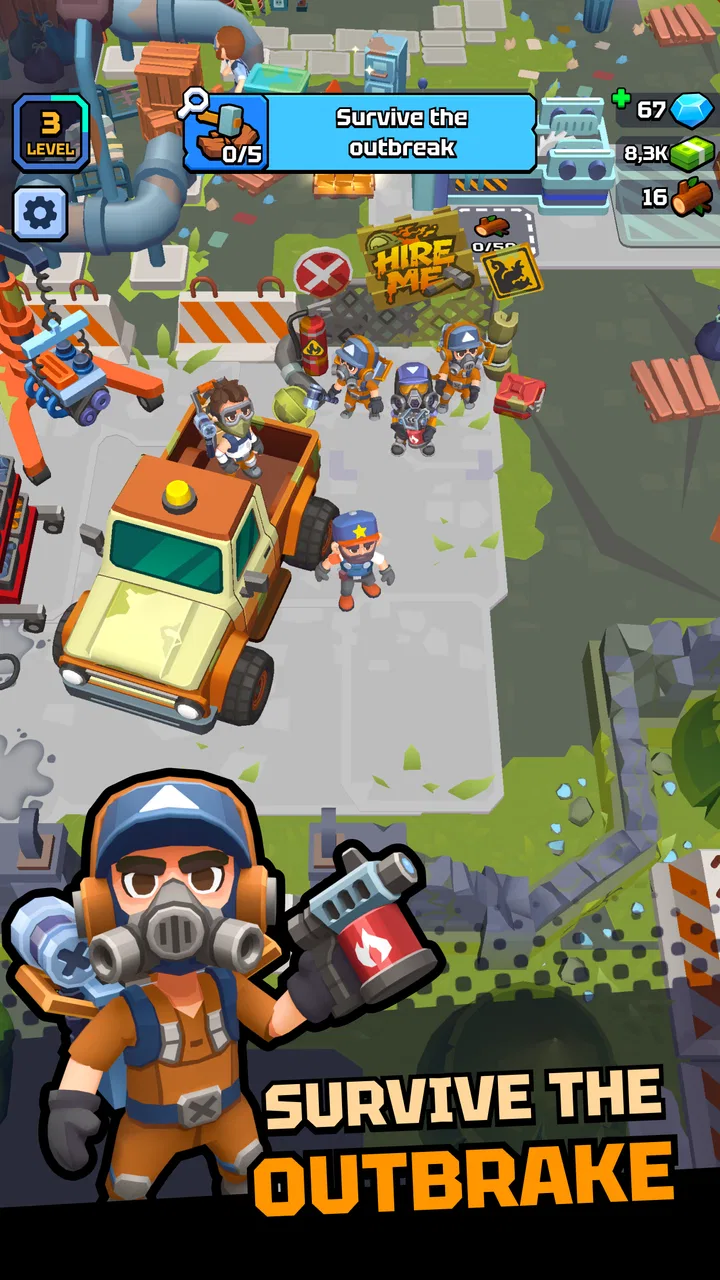
Lost Prison - Shelter Survival
- 4.5
- Rating
- 1.00M
- Installs
- Free
- Price

 Analysis by App-foxy
Lost Prison - Shelter Survival is the kind of arcade game I open when I want a clear objective and quick decisions rather than a complicated control scheme. The setting gives it a stronger identity than a typical score-chasing game: I am trying to keep a damaged prison shelter functioning after an apocalypse, improve what I can, and help survivors rather than simply clearing isolated stages. That combination makes each short session feel connected to the next one.
After spending time with it, I found the appeal comes from its steady loop. I gather what is available, decide which improvements matter most, and push farther into a hostile environment while trying to bring people back safely. It is easy to understand at the beginning, but the choices become more meaningful once several needs compete for attention. The best part is that progress feels practical: every upgrade is tied to making the shelter more capable, not just making a number larger.
Developed by SayGames Ltd, this free arcade game is aimed at Everyone and runs on Android versions from 8.0 onward. It has reached over 500 thousand installs and holds a 4.4 average from around 20 thousand ratings, which fits my impression of a game designed for broad accessibility. The current version is 1.12.0. Optional purchases range from $1.99 to $99.99 per item, so the free entry point is welcoming, but players who dislike monetized progression should pay attention to how often they feel encouraged to spend.
You May Also Like

 Blood Strike: 2.5 Anniversary
Blood Strike’s Loadouts Turn Every Drop Into a Tactical Gamble
A close look at Blood Strike’s custom loadouts: how fast access to signature weapons reshapes its battle royale rhythm, rewards preparation, and narrows the gap between fights.

 Pandora - Music & Podcasts
Pandora’s Music Is Easy to Start, but Harder to Recover
Pandora’s strength is its low-effort path from a seed to a station. Its weak spot is how much confidence it asks you to place in connection, setup, and quiet recovery.

 8 Ball Pool
 Is Built on Rivalries, Rematches, and Routine
A close look at the rivalries, rematches, shared routines, and unanswered safety questions that turn a quick pool match into a persistent mobile community.

 Samsung Music
’s Quiet Strength Is Playing What You Already Own
Its reach comes less from spectacle than from dependable access to a personal library. That simplicity is both the app’s strongest retention engine and its ceiling.

 AccuWeather: Weather Radar
AccuWeather Review: A Quick, Clear Forecast for Everyday Decisions
For everyday plans, the best forecast is the one you can understand quickly. AccuWeather makes rain timing, radar, and local conditions easy to act on, with a few trade-offs.

 Hill Climb Racing
Why Hill Climb Racing Still Turns Crashes Into One More Run
A tiny car, a bumpy hill and one more upgrade: Hill Climb Racing keeps resurfacing because its simple chaos makes every near-miss feel personal.
More From Our News Desk



How the shelter loop builds momentum
I like to think of the shelter phase as a natural handoff point when a device is shared: one person can finish a run, make a considered upgrade, and leave the next player a clear objective. That works better than passing the phone mid-run, when an unfinished risk can make the game feel confusing. From there, it helps to agree on what progress belongs to the person holding the device.
The first goals are simple, but they establish the right priorities
The opening hours work because the game does not bury the main purpose under too many systems. I quickly understand that survival depends on more than moving forward. The shelter needs attention, resources have to be used carefully, and rescuing survivors gives the journey a human reason to continue. That makes the early objectives feel more meaningful than a sequence of disconnected arcade tasks.
My first instinct was to improve whatever looked most immediately useful. That is not always the best approach. A small upgrade that helps me reach a new area can be more valuable than spending everything on a comfortable improvement inside the shelter. On the other hand, ignoring the base for too long makes later runs feel less forgiving. The game gradually teaches a useful habit: think about the next obstacle, not only the reward directly in front of me.
This early balance is one of the stronger design choices. The goals are understandable enough for casual players, yet they leave room for personal priorities. One player may focus on opening routes and rescuing people quickly, while another may prefer to strengthen the shelter before taking a risk. I appreciated that the game gives me a reason to make those decisions without requiring a long tutorial or a spreadsheet.
Progress is visible through what the shelter can do
Progression works best when I can feel a difference in my next attempt. In Lost Prison, the shelter is not just a menu between action sequences. It gives context to the resources I collect and the upgrades I choose. When a previous obstacle becomes manageable because I prepared better, the improvement feels earned. That connection between a run and the shelter is more satisfying than a simple level counter.
A useful approach is to treat every return to the base as a planning break. I look at what I gained, decide whether it supports immediate survival or longer-term growth, and then choose my next objective. Spending everything as soon as it becomes available is tempting, but saving for a more meaningful improvement can make a noticeable difference in how confidently I approach the next challenge.
The game also benefits from its rescue objective. Saving survivors gives progress a clear emotional direction, even though the moment-to-moment play remains arcade-focused. I am not merely collecting abstract rewards; I am trying to expand the group that can survive in the shelter. That framing helps the progression feel more cohesive and keeps the setting involved in the gameplay rather than leaving it as decoration.
One less obvious strength is how the game encourages me to separate “successful” from “efficient.” Returning with something useful may be worthwhile even when I did not complete everything I wanted. That makes partial progress valuable. If I am playing during a short break, I can still make a sensible decision, improve the shelter, and stop without feeling that the session was wasted.
The challenge rises through pressure, not needless complexity
The difficulty curve is most enjoyable when I prepare properly. Early encounters give me enough room to learn the rhythm of collecting, upgrading, and pushing outward. Later, the same basic decisions carry more weight because a poor choice can leave me short of what I need for the next attempt. The game remains approachable, but it gradually asks for better timing and more deliberate resource use.
I would not describe the challenge as purely reflex-based. Planning matters just as much as reacting. Before starting a run, I consider whether I have improved the right part of the shelter and whether the expected reward justifies the danger. That is where the arcade category becomes more interesting: the action is immediate, but the consequences are connected to longer-term decisions.
When a run goes badly, I usually know why. I either pushed too far without enough preparation, spent resources on a lower priority, or treated the next objective as if it were no harder than the previous one. This clarity is important. A difficult game can feel fair when failure points toward a better strategy, and Lost Prison generally gives me that feeling.
There is still some friction in the pacing. Players who prefer constant action may find the shelter management slows the experience, while players who want deep survival simulation may find the decisions lighter than expected. The game sits between those styles. It offers enough planning to make upgrades matter, but it does not turn the prison into a detailed management simulator.
Unlocks are useful when they change decisions
The most satisfying unlocks are the ones that alter how I approach the next objective. A new capability is more interesting when it lets me take a different risk, reach a previously uncomfortable area, or support more survivors. In that sense, the game’s progression is stronger when I view unlocks as tools rather than trophies.
I recommend resisting the urge to chase every available improvement immediately. A practical order is to strengthen whatever helps with the obstacle currently stopping progress, then invest in broader shelter growth once the immediate bottleneck is gone. This prevents resources from being scattered across several upgrades that are individually pleasant but collectively too weak.
That advice is especially useful for free players. Since optional purchases are present, careful spending inside the game matters. I did not need to approach every objective at maximum strength, but I did need to avoid waste. The difference between a smooth session and a frustrating one often came from whether I had a clear reason for an upgrade, not from simply having more resources.
Short sessions work, but the game can create retention pressure
Lost Prison fits naturally into everyday use. I can imagine playing it on a commute, during a lunch break, or while waiting for an appointment. A short session can still include a meaningful run and a shelter decision. The rescue-and-upgrade loop provides a clean stopping point, which is valuable for anyone who does not want a game that demands a long uninterrupted commitment.
At the same time, the structure encourages me to continue after a near-success. When I am close to an upgrade or have just failed to rescue someone, starting another run feels immediately attractive. That is effective pacing, but it can also turn a planned few minutes into a longer session. I found it helpful to stop after completing a clear objective rather than after every attempt, because the game is good at making “one more try” feel justified.
The presence of in-app purchases adds another layer to that pressure. The game is free to start, which makes trying it easy, but the listed purchase range reaches from $1.99 to $99.99 per item. I would recommend deciding in advance whether I am treating purchases as optional convenience or avoiding them entirely. Without that personal boundary, a progression-focused arcade game can make small moments of impatience feel like reasons to spend.
This does not make the game unsuitable, but it affects who will enjoy it most. I think it works well for players who like free games with a gradual loop and are comfortable progressing at their own pace. It is less appealing to someone who wants a completely purchase-free experience or who becomes frustrated when a game repeatedly presents faster progress as an option.
Where it compares with other arcade survival games
Compared with a straightforward arcade game built around high scores, Lost Prison gives me more continuity. My decisions carry into later attempts through shelter development and survivor rescue, so the goal is not erased when a run ends. That makes it a better choice for players who want a sense of building toward something rather than chasing a personal best.
Compared with a full survival-management game, it is more approachable and less demanding. I do not need to monitor a large collection of detailed systems to understand what I should do next. The trade-off is depth. Players looking for elaborate crafting chains, complex settlement layouts, or a highly realistic survival model may prefer a more specialized alternative.
Its middle position is both its strength and its limitation. The arcade structure keeps the game readable, while the shelter gives the action a reason to continue. However, anyone expecting the breadth of a deep strategy game should adjust expectations. I see it as a compact survival adventure with management decisions, not as a replacement for a serious colony simulator.
A practical routine for getting more from each attempt
My most reliable routine is to begin by identifying the next concrete barrier instead of automatically selecting the most visible upgrade. I then use the shelter phase to support that goal, enter a run with a defined purpose, and return once the risk becomes disproportionate to the likely reward. This keeps the loop controlled and reduces the feeling of wandering through objectives.
I also found it useful to judge a run by three outcomes: what I brought back, whether I moved closer to a rescue, and whether I learned something about the next difficulty step. If only one of those goes well, the attempt can still be worthwhile. This mindset prevents unnecessary frustration and makes the game’s incremental design easier to appreciate.
For a player sharing a device with a younger family member, the Everyone rating makes the game broadly accessible, but I would still explain the purchase system before handing it over. For an adult looking for a calm game, the post-run planning may be more engaging than the action itself. For someone who wants intense competition, the lack of a score-first identity may make it feel too measured.
My verdict on the progression and pacing
Lost Prison - Shelter Survival succeeds when its goals remain connected: gather what helps, improve the shelter, take a calculated risk, and rescue survivors. The progression has enough structure to keep me interested without becoming difficult to decode. I especially liked that failure usually suggested a planning correction rather than making me feel completely stuck.
Its limitations are equally clear. The experience is not aimed at players who want a deep simulation, uninterrupted action, or a monetization-free environment. The pacing can also feel slower when I am waiting for a meaningful upgrade or repeating a familiar objective. Those are reasonable trade-offs for its accessible design, but they should shape expectations before downloading.
As a free arcade game, it offers a convincing reason to return beyond the first few minutes. The shelter gives each attempt context, the rescue goal adds direction, and the gradual rise in difficulty rewards attention to preparation. I would recommend it to anyone who enjoys compact survival loops and likes seeing a damaged base become more capable over time.
My final advice is to play patiently, upgrade with a purpose, and treat purchases as optional rather than necessary shortcuts. If that approach suits you, the game’s steady rhythm can be surprisingly absorbing. It is at its best when I stop chasing instant progress and start treating every run as one deliberate step toward a more secure shelter.
FAQs for Lost Prison - Shelter Survival
01What is the main objective of Lost Prison - Shelter Survival?
Lost Prison - Shelter Survival is a strategic survival game where players must navigate through a post-apocalyptic world. The primary objective is to manage resources, build shelters, and ensure the survival of your character against various threats. Players must make critical decisions to overcome challenges and uncover the secrets of the lost prison.
02Is Lost Prison - Shelter Survival free to play?
The game is free to download and play, but it may contain in-app purchases. These purchases can enhance gameplay by providing additional resources, unlocking premium features, or offering cosmetic upgrades. Players can enjoy the core experience without spending money, but some may choose to purchase items to progress faster.
03What platforms is Lost Prison - Shelter Survival available on?
Lost Prison - Shelter Survival is available on both Android and iOS platforms. Users can download the game from the Google Play Store for Android devices and the Apple App Store for iOS devices. Ensure your device meets the minimum system requirements for optimal gameplay performance.
04What are the system requirements for Lost Prison - Shelter Survival?
To play Lost Prison - Shelter Survival, Android users need a device running Android 6.0 or higher, while iOS users require an iPhone or iPad with iOS 11.0 or later. Adequate storage space is necessary for installation, and a stable internet connection enhances the multiplayer and social features of the game.
05Does Lost Prison - Shelter Survival feature multiplayer modes?
Yes, Lost Prison - Shelter Survival includes multiplayer modes where players can team up with friends or other online survivors. Collaborate to build more robust shelters, share resources, and strategize to overcome the game's challenges together. The multiplayer experience adds an engaging social dimension to the game.
Pros
- Engaging storyline with unexpected twists.
- Intuitive controls enhance gameplay experience.
- Diverse missions keep players challenged.
- Rich graphics create immersive environments.
- Frequent updates add new content regularly.
Cons
- In-app purchases can be quite costly.
- Occasional lag on older devices.
- Requires constant internet connection.
- Limited character customization options.
- Some missions feel repetitive over time.

Lost Prison - Shelter Survival
Gallery